
Reskilling: Your Pivot Point in 2026
How to switch career directions without starting over
A new era of change
We’re living through a career era where “stable” means “adaptable.” Tools change. Roles evolve. Teams restructure. Whole functions get redesigned around AI, automation, and new business models.
If you’ve felt that subtle pressure of, “Wait…will my role still look like this in a couple years?” you’re not behind. You’re just paying attention.
Reskilling is what you do when you look at that reality calmly, and choose to move with it.
1. What reskilling is
Reskilling means learning a new set of skills for a different role or a meaningfully different path. It’s deeper than updating your toolkit. It’s rebuilding capability for a new lane.
Reskilling often shows up when:
Your current role is shrinking, being automated, or no longer energising you.
Your industry is changing faster than your role can evolve.
You want a cleaner reset into a direction that fits your values, identity, and future goals.
The World Economic Forum’s Future of Jobs Report 2025 points to major labour market transformation by 2030, including significant job disruption and a strong need for workers to adapt. That’s one of the biggest reasons reskilling has moved from “nice idea” to “career reality.”
2. Why reskilling matters right now
Reskilling matters because the market is rewarding range and reinvention.
AI is changing tasks inside roles, and in some cases changing roles entirely. Many organisations are still early in adoption, but the direction is clear: work is being redesigned. McKinsey’s 2025 AI workplace research notes that most companies are investing, while very few consider themselves mature in how they use AI. That gap creates volatility for roles, and upside for people who learn proactively.
Reskilling also matters because it expands your options. When you can move lanes, you’re less dependent on one job market, one employer, or one title.
3. Reskilling vs. upskilling
Let’s break this down simply.
Upskilling: you get better at the skills inside your current lane.
Reskilling: you build capability for a new lane.
Here’s a simple self-check: if you like your industry but your role is getting outdated, you upskill. But if your role or industry no longer fits your values, energy, or future vision, you reskill.
If you want to learn more about upskilling, we’ve got you covered.
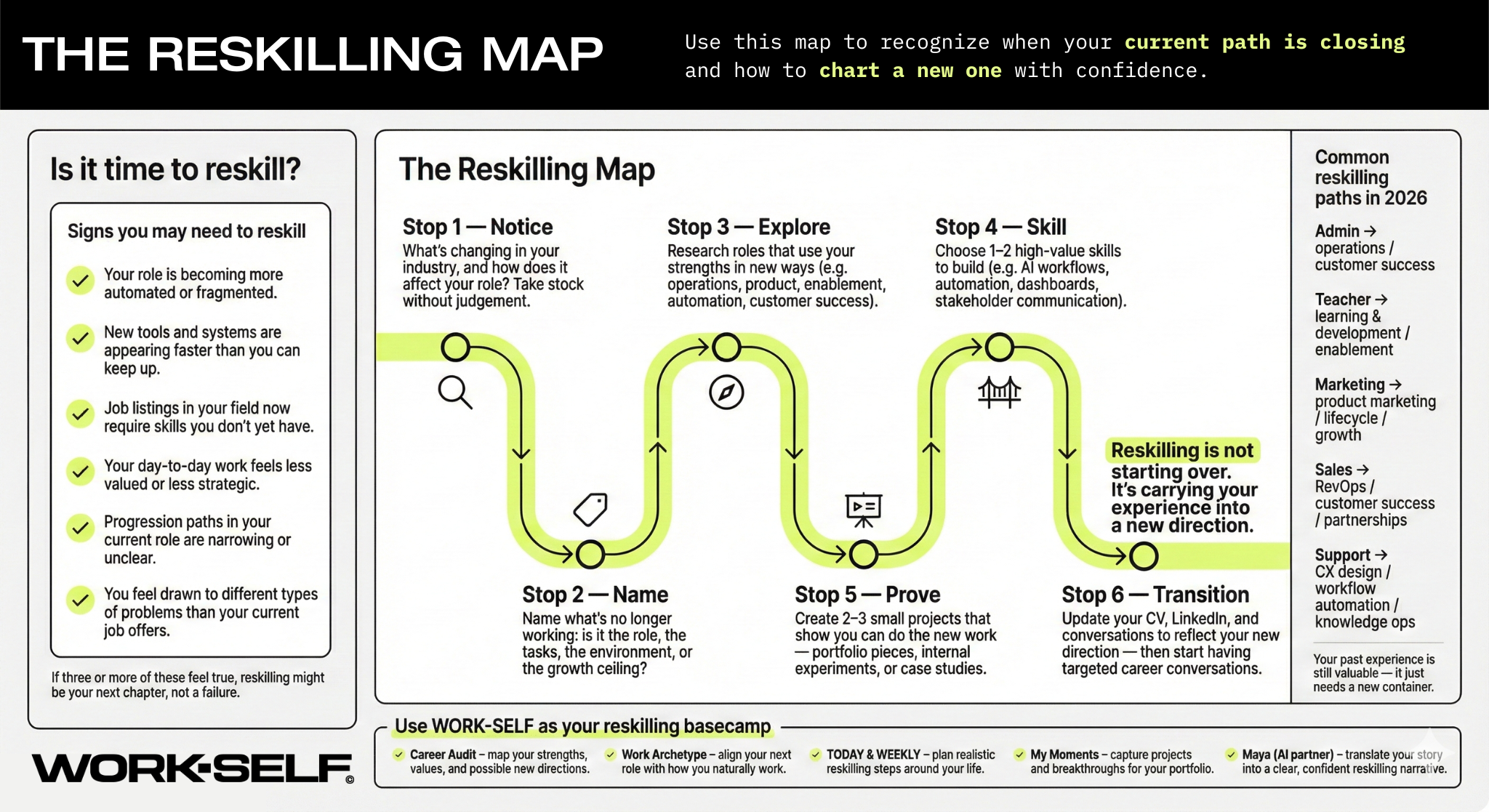
4. The reskilling map: a simple 4-step framework
Here’s the framework I use when someone says, “I think I need to change direction, but I don’t know where to start.”
4.1 Identify what’s actually changing
Write down:
What tasks in your role are becoming automated or compressed?
What parts of your role still require human judgment, trust, creativity, or leadership?
What work do you enjoy enough to keep doing for 3–5 years?
This is not about fear. It’s about clarity.
4.2 Choose a “next role family,” not a single job
Reskilling gets easier when you pick a role family (a cluster of adjacent roles), like:
Operations → business operations / program management / RevOps
Marketing → growth / lifecycle marketing / marketing ops
Support → customer success / enablement / community
Admin → project coordination / people ops / operations
Pick something close enough that your experience still matters.
4.3 Build a bridge skill stack (3 skills only)
People stall because they try to learn everything at once. Your goal is a bridge.
Pick:
One core skill (the engine of the new lane)
One support skill (makes you useful fast)
One credibility skill (signals readiness)
Example: moving into data-driven ops
Core: data analysis + dashboarding
Support: automation (Zapier/Make/n8n)
Credibility: basic SQL or metrics storytelling
4.4 Prove it with one small outcome
Reskilling becomes real when there’s evidence.
Build:
a sample dashboard,
a workflow automation,
a mini case study,
a lightweight portfolio doc.
Even one good artifact changes how recruiters and hiring managers perceive you.
5. A realistic reskilling timeline (without burnout)
A healthy reskill often follows a rhythm like this:
Weeks 1–2: direction clarity + role family + bridge skills
Weeks 3–6: learn + practice in tiny daily loops
Weeks 7–10: build proof (portfolio / projects)
Weeks 11–12: update CV/LinkedIn + begin applications or internal mobility
This is also what the OECD emphasizes in adult learning contexts: reskilling works best when supported by strong systems, practical relevance, and accessible pathways.
-
If you could press “refresh” on your career without losing your identity, what would you move toward?
6. What most people get wrong about reskilling
These are the common pitfalls of those embarking in a new direction:
They try to reskill with zero clarity, and lose momentum.
They learn passively (courses only) without building proof.
They treat reskilling like a sprint, then burn out.
They underestimate what they already know and start from scratch unnecessarily.
A reskill is rarely a full reinvention. More often, it’s a thoughtful reconfiguration of strengths.
7. Where WORK-SELF fits
Reskilling succeeds when you have a system for clarity and follow-through. WORK-SELF supports the parts that people usually struggle with:
staying consistent,
tracking progress,
keeping emotional steadiness through uncertainty,
maintaining direction week to week.
If you’re reskilling, you don’t need more pressure. You need a structure you can live inside. That’s what WORK-SELF offers.
8. Conclusion
Reskilling is not a crisis response. It’s a career advantage. It’s how you keep your options open, raise your earning ceiling, and build work that still fits you as the world changes.
You do not need to know the whole path. You only need the next clear step, and the rhythm to take it.
9. FAQs
9.1 Do I need to quit my job to reskill?
No. Most reskilling works best when you keep financial stability and build your bridge in parallel.
9.2 How do I know what to reskill into?
Start from what you already do well, then move one lane over. Choose a role family, not a perfect job title.
9.3 What if I feel too old or too late?
Many people reskill mid-career. The real predictor is not age, it’s consistency and clarity.
9.4 Do I need a degree?
Sometimes, but often you need proof. A portfolio artifact, case study, or project can carry enormous weight.
