

AI transformation fails at the handoff between AI and people
Maya Enterprise, a WORK-SELF offering, is the Human and AI Work Orchestration platform for enterprise transformation. It maps how work and roles are changing, defines how people and AI agents share responsibility, and gives approved agents the context and capabilities required to move work forward without making accountability ambiguous.









33%
less rework in agentic workflows by giving agents the human context.
112,000
skilled hours returned annually in workflows involving min 250 employees.
30 days
to get Maya live
across all enterprise workflows. 100M+ tasks automated.
12,000+
routing accuracy for AI agent initiated workflows and issue resolutions.
97%
enterprise applications available to connect across your existing technology stack and maintain 99.9% uptime.
More AI output is not the goal. Get the work right the first time.
AI agents work better when they know what they are responsible for, what context they can use and when a person needs to step in. Maya makes those boundaries clear, so agents can move work forward without losing human judgement or accountability.
-
See who is ready, where roles are changing and where support is needed. Realise increased efficiency in agentic workflows by:
mapping 5x more skills captured per employee
routing over 315,000 tasks via automated workflows
adding 21,000 hours of manual time saved
-
Set who owns the work, what the agent can do, what requires human approval and when to escalate.
50+ controls across AI governance
100% of deadlines tracked and chased automatically
64% fewer escalations to HR
-
Give agents only the task, role, policy and human context they are authorised to use. Better context helps agents find what they need, resolve more work directly and avoid unnecessary handoffs.
Answers 80% of employee requests from Slack and Teams, and runs the processes behind them
By adding human context, Maya cuts information search times by 50%
80% of requests resolved without creating a service ticket or requiring escalations
-
Track rework, corrections, intervention and whether the workflow is performing as intended.
100% of AI-generated insights pass automated validation for accuracy, coherence, and safety
30% average increase in delivered output
60% improvement in cost per unit of delivered work
Agents act with the right permissions
•
Only show what agents need
•
People approve key decisions
•
Every action is recorded
•
Agents act with the right permissions • Only show what agents need • People approve key decisions • Every action is recorded •
Clear ownership
•
Less rework
•
Safer agent context
•
Human judgement stays visible
•
Clear ownership • Less rework • Safer agent context • Human judgement stays visible •
Successful AI workforce transformation depends on human adaptation more than technology
70% of AI transformation programmes fail not because the technology is wrong, but because the human layer has little structured support. Organisations know which workflows AI will take. They often don't know which employees will thrive, which will resist, and which will quietly leave. In a 1,000-person transformation programme, for example, that is a £7–17M problem.
Workforce Reinvention
Assessment
See where the workflow is creating friction
Maya checks in with employees as agent assisted work changes, helping identify where output creates rework, where ownership is unclear and where human support is still required.
Maya, AI Workforce
Transition Agent
Guide the employee through what changes next
Maya turns workforce readiness and changing role requirements into practical next steps, helping each employee understand what to learn, what they continue to own and where AI should support them.
Human-AI Workflow
Orchestration
Give agents the context to work better with each person
Maya connects approved employee context with workflow rules so agents can account for working preferences, permissions, review requirements and escalation without removing human judgement.
Results we generate for organisations
-
![]()
Kept agentic workflows moving without becoming the bottleneck
I was being asked to review around 50 pieces of agent generated work a day. I was spending too much time rereading work because I was not always clear what needed a full review, what could be approved quickly and when I actually needed to step in.
Maya helped me understand what I was accountable for, what I needed to check and what the agent could handle without me. I had a much clearer way to review and approve work without slowing everything down.
Results: Agent output moved through review and approval with much clearer boundaries. I spent less time repeating work the agent had already completed and could focus my attention on the decisions that genuinely required human judgement.
Metrics impacted: Saved 11 hours of productivity per week, and 38% less manager admin time.— Daniel W., Operations Lead who navigated a role change during an AI transformation programme
-
![]()
Redeployed in six weeks, no external hire needed
We had a finance professional whose role was being significantly changed as more work moved into agent enabled workflows. He was capable, but unclear about where his experience would fit in the new operating model and how his role should work alongside AI agents.
Maya helped us map his strengths against the new operating model, identify where human judgement was still required, and focus his development on the capabilities the new role needed. That gave both the employee and the organisation a clearer view of where his experience could continue to create value as the work changed.
Results: He was successfully redeployed into a Data and Insights role within six weeks. There was no external hire and no replacement cost. He entered the new team with a clear understanding of how to work alongside agents, which responsibilities remained his, and where he remained accountable.
Metrics impacted: 60% reduction in time-to-fill internal roles, and 2.8x increase in internal mobility.— HR Director, Financial Services firm, 1,200-employee digital transformation programme
-
![]()
New workflow running smoothly in three weeks
Our team had introduced more AI into the workflow, but the handoffs between people and agents were not working as clearly as they needed to. Work was being reviewed more than once, ownership was not always obvious, and employees were spending time checking output that did not necessarily require their attention.
Maya helped make the workflow explicit. We could see what the agent owned, what the employee owned, where human review was required, and when the work needed to move to someone else. Instead of relying on people to work out those boundaries as the workflow moved, the responsibilities were clear from the start.
Results: Within three weeks, the workflow was running with clearer ownership, fewer unnecessary handoffs and less duplicated effort. Employees could spend more time on the parts of the work that needed their judgement rather than repeatedly checking work that had already been completed.
Metrics impacted: 10x faster across reporting, workflows, and admin, and 40% reduction in time spent building forms and workflows.— Sarah M., Product Manager navigating an AI-driven team restructure
-
![]()
Retained a strong performer we expected to lose
Emma was flagged as an attrition risk three months into our AI workflow rollout. Her design function had changed substantially and she was disengaged. We had no systematic way of knowing whether the new version of her role actually suited her, or whether we needed to find her an alternative pathway within the organisation.
Maya gave us a clearer picture of how her strengths mapped against the changing role and gave her a structured way to work through the decision rather than making it by default.
Results: She moved into a different role within the organisation that was a better fit for her strengths and experience. Twelve months on, she is still with us. The alternative was a resignation and a £40,000+ replacement process.
Metrics impacted: 35% improvement in workforce planning and 100% matching accuracy.— People & Culture Lead, Technology company, post-AI restructure cohort of 340 employees




Meridian Capital Partners: Workforce Reinvention Intelligence in Financial Services
Case Study
This Maya Enterprise simulation shows how a 1,200-person UK investment management and corporate advisory firm could de-risk AI-driven transformation before announcing workflow change to its people. Across a 312-employee cohort in Research, Compliance, and Client Advisory, Maya deployed its identity-aware intelligence architecture to assess reinvention readiness, identify high-risk disengagement and departure signals, surface internal mobility opportunities, and generate personalised 30/60/90-day transition plans for every affected employee. The simulation identified 34% of the cohort as High or Critical Risk, addressed £4.2M in estimated people failure exposure, and became operational within 28 days. Beyond workforce diagnostics, the case study points toward Maya’s broader role as a Human-AI orchestration layer: helping enterprises understand not only which workflows AI will transform, but how each employee should be supported, redeployed, coached, and paired with AI systems so transformation lands in the workforce rather than breaking against it.
See how agentic workflows are landing across the business
Maya gives leaders workforce intelligence, operating controls and evidence they need to make different parts of the agentic programmes succeed.
-
See realised value, productivity and wasted agent spend. Increased visibility into agentic deployments can results in a 25%+ reduction in agent spend that produced unaccepted output.
-
See who is ready for new ways of working and where teams need support. Maya can help employees become productive in new workflows 50% faster.
-
See where work is getting stuck between people, agents and processes. Maya can achieve 97% routing accuracy across workflows.
-
See agent activity, access controls and security across the enterprise. Maya can reduce inactive agent and service accounts by 96%.

Prove one employee-AI workflow before scaling.
Step 1: Choose the workflow
Select one agent assisted workflow where ownership, review, correction or escalation still creates avoidable human effort.
Step 2: Establish the baseline
Agree the cohort and measures that matter, such as correction rounds, cycle time, rule adherence, intervention and skilled hours spent on review.
Step 3: Define and connect the operating model
Set decision rights, Work Contracts, review points and escalation. Connect the approved systems and serve the context required by the agent. We maintain enterprise-grade certifications and automated controls, ensuring adherence to SOC 2 Type II, ISO 27001, PCI DSS, and GDPR standards.
Step 4: Measure the result and decide what scales
Compare performance against the baseline and identify where the operating model should expand next. In a client project, Maya is capable of governing 60K agents per week across departments.
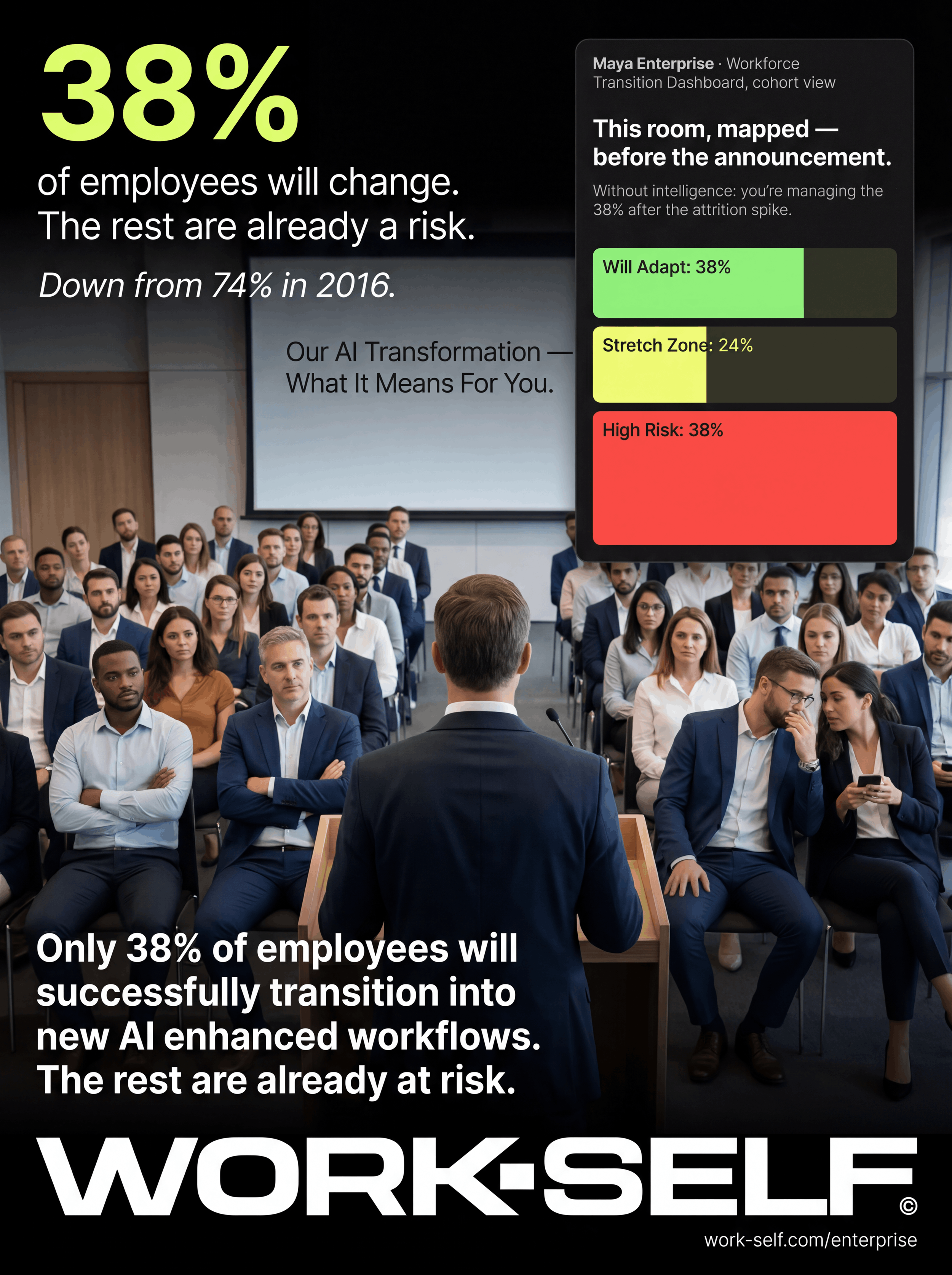
Run the Workforce Reinvention Assessment before the announcement
Every organisation in an AI transformation has the same problem. They know what the new workflow looks like. They do not know which employees will land on the right side of it.
Maya Enterprise deploys across your affected cohort in 30 days. Before the programme is announced, you have a complete readiness map: who will adapt, who needs support, and who is already at risk of quiet exit.
The boardroom conversation shifts from "how do we communicate the change?" to "which employees need intervention before we make it?"