
Upskilling: Turn Learning into Income
Every industry evolution is a fresh opportunity for growth
The pathway to career confidence
Upskilling is one of the most underrated career moves because it looks small on the outside. It can feel like “just learning something.” Quiet improvement. A new tool. Better communication. Stronger execution.
Then, over time, it changes everything: the projects you’re trusted with, the conversations you can lead, the salary bands you’re eligible for, and the confidence you carry.
1. What upskilling is
Upskilling means improving and expanding the skills that make you more effective in your current role or career direction. You are still in the same lane, but you’re moving faster and with more range.
Upskilling is ideal when:
You like your work, but want more income, influence, or mobility.
Your role is evolving and you want to stay ahead of expectations.
You want promotion readiness and stronger positioning in your industry.
2. Why upskilling is a career accelerator in 2026
Work is moving faster, and skill expectations are spreading across roles. AI and digital workflows have changed the baseline.
LinkedIn’s Workplace Learning Report 2024 emphasizes how learning is tied directly to organisational agility and career development, especially with AI accelerating change.
McKinsey has also highlighted that upskilling and reskilling are now central priorities as gen AI reshapes work.
The opportunity is simple: when you increase your leverage, your income tends to follow.
3. Upskilling vs reskilling
Ask: “Am I trying to grow in my lane, or change lanes?”
Grow in your lane? That’s upskilling.
Change lanes? That’s reskilling (which we also cover).
4. The upskilling loop: learn > apply > prove
Upskilling fails when it becomes “content consumption.” It succeeds when it becomes a loop.
4.1 Learn (small and specific)
Pick one skill that improves your day-to-day work.
Examples:
AI workflow design for faster output
data literacy for better decision-making
stakeholder communication for leadership presence
4.2 Apply (inside your real work)
Choose a real task you already do and upgrade it.
Turn a manual report into a dashboard.
Turn a messy meeting into a clear decision memo.
Turn a repetitive process into an automation.
4.3 Prove (create evidence)
Evidence makes growth visible:
“Reduced reporting time by 30% using automation”
“Built a weekly dashboard used in leadership review”
“Created a template that cut stakeholder confusion in half”
Reflection: What part of your current job would become easier if you improved just one skill?
5. What to upskill in
The best upskilling targets tend to fall into 5 areas:
AI + automation fluency
data interpretation
communication and influence
execution and prioritisation
systems thinking
If you want a quick rule: upskill in skills that save time, reduce errors, build trust, or improve decisions.
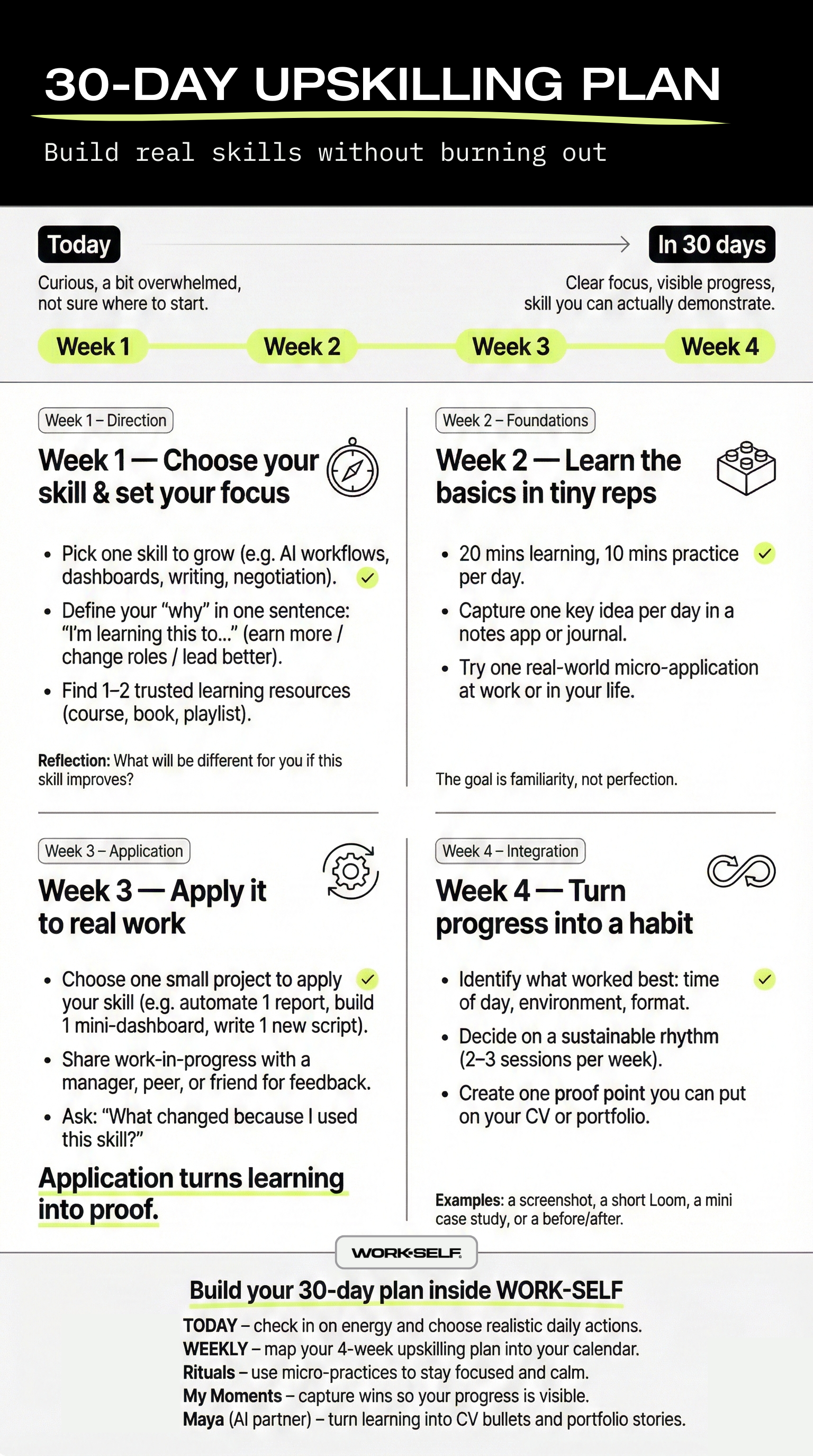
6. A 30-day upskilling plan that actually works
Here’s a practical plan that respects real life.
Week 1: Choose + set baseline
Pick one skill.
Define one measurable output you’ll improve.
Week 2: Practice in micro-sessions
20 minutes a day.
One small task upgraded daily.
Week 3: Build one “proof asset”
a workflow
a dashboard
a system map
a one-page case study
Week 4: Translate it into career language
Update CV bullets
Update LinkedIn headline/about
Prep one story for interviews or promotion conversations
7. Common upskilling mistakes
Here are the most common traps that learners fall into:
Learning too many skills at once.
Taking courses without applying them.
Measuring effort instead of outcomes.
Waiting for permission to use new skills.
Upskilling is not about collecting knowledge. It’s about upgrading your leverage in a demonstrable, visible way.
8. Where WORK-SELF fits
Upskilling usually breaks down at consistency: people start strong, then life interrupts. WORK-SELF supports upskilling by keeping you aligned and steady:
TODAY check-ins for energy and focus
WEEKLY planning for realistic goals
My Moments for tracking proof of progress
Maya for prompt support, skill practice, and clearer action steps
Upskilling becomes easier when your learning is structured like a rhythm rather than another obligation.
9. Conclusion
Upskilling is one of the cleanest ways to increase income because it increases your competence, your confidence, and your usefulness. It also makes you more future-proof, because you can adapt as roles evolve.
You do not need to learn everything. You need to learn the next right thing, then apply it until it becomes yours.
10. FAQs
10.1 How long does upskilling take?
You can see meaningful results in 4–8 weeks if you apply skills to real work consistently.
10.2 Do I need certificates?
Sometimes they help, but proof of impact usually helps more.
10.3 What if I don’t know what skill to pick?
Pick the skill that removes the biggest pain in your current week. That’s your highest leverage starting point.
10.4 Can I upskill while overwhelmed?
Yes, if you keep it small and consistent. Tiny upgrades compound.
