

AI transformation fails at the handoff between AI and people
Maya Enterprise, a WORK-SELF offering, is the Human and AI Work Orchestration platform for enterprise transformation. It maps how work and roles are changing, defines how people and AI agents share responsibility, and gives approved agents the context and capabilities required to move work forward without making accountability ambiguous.
Measured Impact
Better agent output is useful. Accepted work creates capacity.
33%
Less colleague rework
Correction rounds reduced from 3 to 2.
(Controlled evaluation)
112,000
Skilled hours returned
Annualised capacity from one correction round removed.
(Measured from client outcomes)
30
To operational
One cohort. One workflow. One measurable starting point.
(Enterprise deployment commitment)
More AI output is not the goal. More accepted work is.
Make the human operating model explicit before you scale the agent…
-
See who is ready, where role fit is changing and where support is required.
-
Set ownership, permitted agent actions, review points, deadlines and escalation.
-
Give approved agents only the task, role, policy and work context required for the workflow.
-
Track correction, intervention, workflow performance and operating capacity, not only model output.
… for Enterprise control to stay in place.
Agents act with the right permissions
•
Only show what agents need
•
People approve key decisions
•
Every action is recorded
•
Agents act with the right permissions • Only show what agents need • People approve key decisions • Every action is recorded •
Clear ownership
•
Less rework
•
Safer agent context
•
Human judgement stays visible
•
Clear ownership • Less rework • Safer agent context • Human judgement stays visible •
Help people adapt as AI changes the work around them
Maya stays with employees as roles, workflows and AI responsibilities change. It surfaces where agent assisted work is creating friction, guides each person through the transition, and carries the right human context into the workflows where people and agents work together.
Workforce Reinvention
Assessment
See where the workflow is creating friction
Maya checks in with employees as agent assisted work changes, helping identify where output creates rework, where ownership is unclear and where human support is still required.
Maya, AI Workforce
Transition Agent
Guide the employee through what changes next
Maya turns workforce readiness and changing role requirements into practical next steps, helping each employee understand what to learn, what they continue to own and where AI should support them.
Human-AI Workflow
Orchestration
Give agents the context to work better with each person
Maya connects approved employee context with workflow rules so agents can account for working preferences, permissions, review requirements and escalation without removing human judgement.
Maya in practice: for transformation leaders to employees
Maya gives leaders visibility into where AI enabled work is succeeding, where it is creating hidden effort, and where employees need clearer ownership, context or support.
-
![]()
People / Workforce Transformation Leader
See who needs support before the rollout stalls
Introducing AI changes more than tasks. It changes roles, confidence, skills and the way responsibility moves through the organisation.
Maya maps workforce readiness and transition needs alongside the changing workflow, helping leaders identify where support, redeployment or intervention is required.
What the organisation gains: a clearer view of readiness, transition risk and where human capability needs to change as agent adoption expands.
-
![]()
COO / Transformation Leader
See where AI is creating value, and where it is still creating work
AI adoption can look successful while employees quietly absorb the correction, coordination and escalation burden.
Maya gives transformation leaders visibility into rework, human intervention, workflow performance and workforce readiness so they can see where the operating model still needs attention.
Measured outcome: In a controlled customer deployment, correction rounds fell from three to two and adherence to ownership, review, escalation and deadline rules increased from 32% to 74%.
-
![]()
Customer Service Manager
Reduce rework at the human and agent handoff
When agents miss the right owner, review route or escalation point, managers and employees become the manual control layer.
Maya gives approved agents the task, role, policy and employee context required for the workflow, while keeping review and escalation responsibilities clear.
What the manager sees: where corrections happen, which workflows create repeat intervention, and where agent instructions need to change.
-
![]()
Employee in an AI assisted workflow
Know what the agent owns, what you own, and when to step in
Employees should not have to work out the operating model themselves every time AI enters a workflow.
Maya makes responsibilities, review expectations and escalation boundaries visible, while giving the agent only the human context required for the task.
For the employee: less ambiguity, less repeated correction and clearer responsibility for the final outcome.




Meridian Capital Partners: Workforce Reinvention Intelligence in Financial Services
Case Study
This Maya Enterprise simulation shows how a 1,200-person UK investment management and corporate advisory firm could de-risk AI-driven transformation before announcing workflow change to its people. Across a 312-employee cohort in Research, Compliance, and Client Advisory, Maya deployed its identity-aware intelligence architecture to assess reinvention readiness, identify high-risk disengagement and departure signals, surface internal mobility opportunities, and generate personalised 30/60/90-day transition plans for every affected employee. The simulation identified 34% of the cohort as High or Critical Risk, addressed £4.2M in estimated people failure exposure, and became operational within 28 days. Beyond workforce diagnostics, the case study points toward Maya’s broader role as a Human-AI orchestration layer: helping enterprises understand not only which workflows AI will transform, but how each employee should be supported, redeployed, coached, and paired with AI systems so transformation lands in the workforce rather than breaking against it.
Human expertise when transformation needs it
Maya identifies where employees, managers and transformation leaders need human support. Approved specialists can then support high judgement moments such as role transition, leadership alignment and workforce change without replacing the organisation’s existing people processes.
-
Support leaders defining how roles, responsibilities and decision rights change as AI enters the workflow.
-
Give managers structured support when an employee needs additional transition, role or performance guidance.
-
Bring qualified human expertise into complex redeployment or reinvention decisions where software alone is not enough.

Prove one employee-AI workflow before scaling.
Step 1: Choose the workflow
Select one agent assisted workflow where ownership, review, correction or escalation still creates avoidable human effort.
Step 2: Establish the baseline
Agree the cohort and measures that matter, such as correction rounds, cycle time, rule adherence, intervention and skilled hours spent on review.
Step 3: Define and connect the operating model
Set decision rights, Work Contracts, review points and escalation. Connect the approved systems and serve the context required by the agent.
Step 4: Measure the result and decide what scales
Compare performance against the baseline and identify where the operating model should expand next.
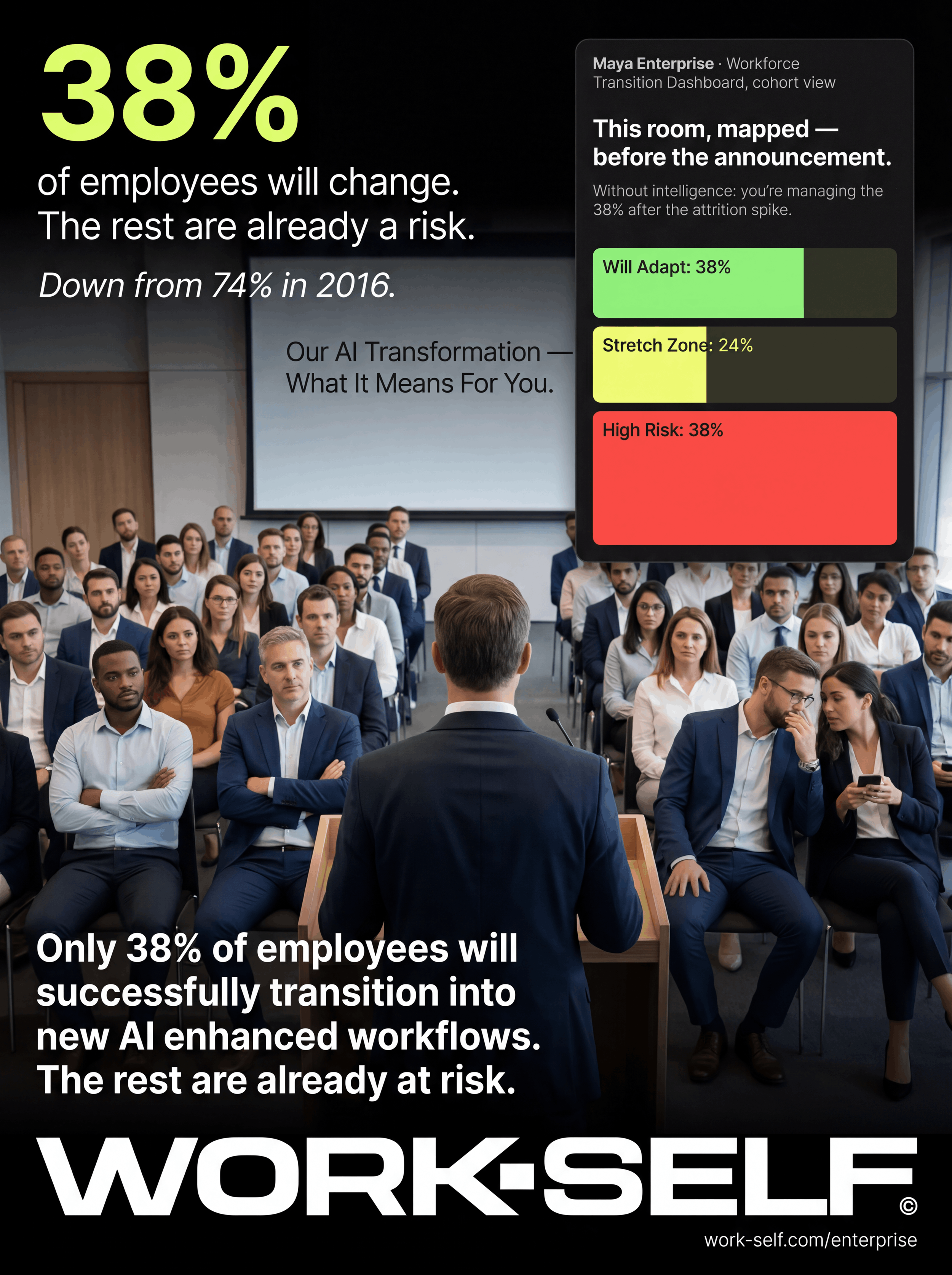
Run the Workforce Reinvention Assessment before the announcement
Every organisation in an AI transformation has the same problem. They know what the new workflow looks like. They do not know which employees will land on the right side of it.
Maya Enterprise deploys across your affected cohort in 28 days. Before the programme is announced, you have a complete readiness map: who will adapt, who needs support, and who is already at risk of quiet exit.
The boardroom conversation shifts from "how do we communicate the change?" to "which employees need intervention before we make it?"